
The Concessions Tax and Why We Should Stop Accepting Long Lines as an Industry Standard
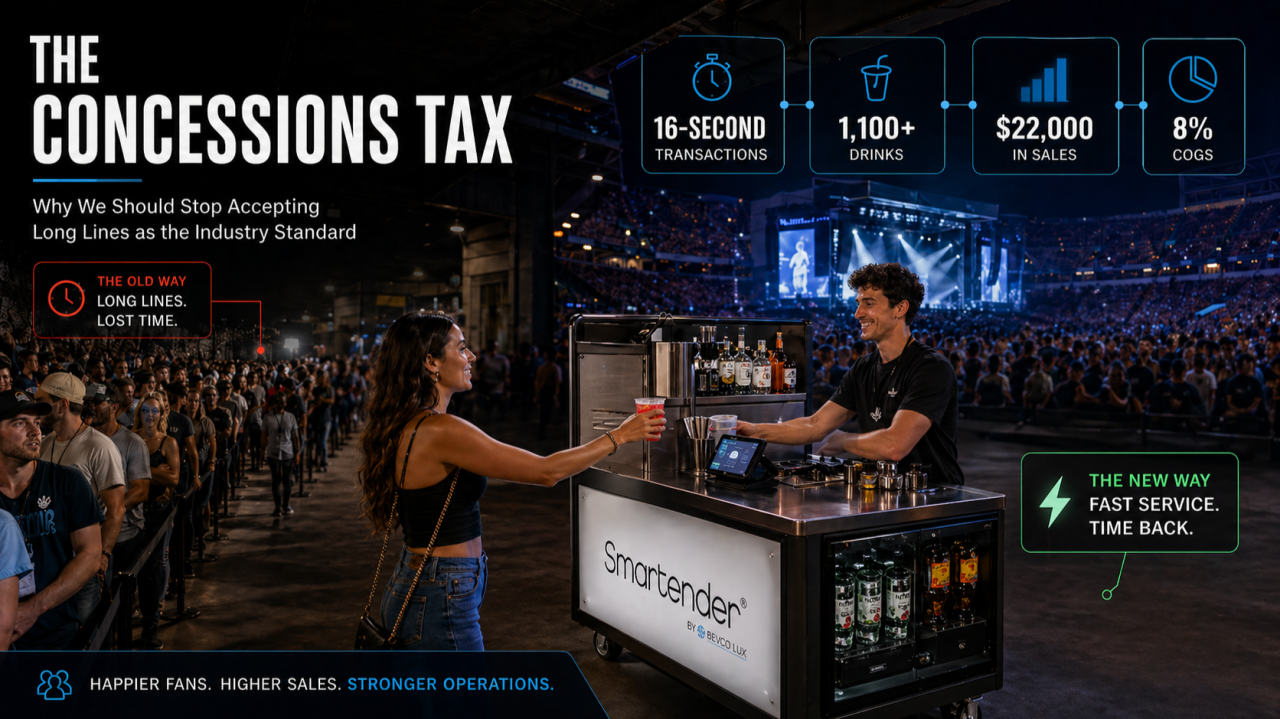
In the stadium and arena industry, we have a collective blind spot. We’ve come to view the 20-minute concessions line as a "normal" part of the fan experience—a literal tax on the guest’s time. We’ve accepted that high-volume service requires a trade-off: you either get quality, or you get speed, but you rarely get both.
At a recent record-breaking concert in a 91,000-seat Midwest stadium, we set out to prove that this "normal" is actually a systemic failure. By shifting the burden of production away from human intuition and onto a high-precision system, we didn't just sell drinks; we gave the fans their time back.
The "Frictionless" Return Rate
The most telling metric of the night wasn’t found on a spreadsheet, but in the behavior of the crowd. Anecdotally, we saw the same guests returning 3 to 5 times throughout the evening.
In a traditional concessions environment, a guest will often wait until they are desperate for a drink because the "cost" of the line—missing the show, the physical wait, the friction—is too high. By maintaining a 16-second transaction floor, we removed that psychological barrier. When the line isn't a hurdle, the guest returns. That is the definition of frictionless revenue.
Systems Outperform "Experience"
The industry remains obsessed with finding "the best bartenders." But at a stadium level, the individual doesn't scale; the system does.
During this event, our two Smart Bar units were operated by volunteers from a local charity with limited to no bartending experience. They were trained in under an hour. Yet, the results outperformed industry veterans:
$22,000 in liquor sales from just two portable units.
1,100+ drinks produced in a 5-hour window.
220 drinks per hour sustained output....That's a drink every 16 seconds my friends!
8% COGS maintained through precision pouring.
We proved that you don’t need a lifetime of craft experience to produce high-volume, high-quality cocktails. You need a system that empowers anyone to be an expert in 60 minutes.
The 30% Efficiency Gap
What is most striking is that these record-breaking numbers represent a throttled version of the system.
Our architecture is designed to receive tickets directly from the POS to the production line. Due to the venue's IT constraints during this limited pilot, we had to rely on manual communication. Even with this bottleneck, we hit 16-second transactions. With full IT integration, efficiency would have increased by an additional 30%. In a high-stakes environment, that 30% isn't just a margin improvement—it is the difference between a satisfied guest and a lost sale.
Scalability: From a Section to a Stadium
This pilot was contained to a single area of the stadium, with both units operating side-by-side. The impact was localized to the fans in that specific section who were lucky enough to experience it.
The real thought leadership challenge for stadium operators is this: What happens when we stop thinking in "stands" and start thinking in "systems"?
If this function were replicated with just eight units spread strategically throughout the stadium, the impact on the bottom line and the guest experience would be exponential. We are no longer limited by the "talent" available in the local labor pool; we are only limited by how many units we choose to deploy.
The Bottom Line
Speed is more than just a logistical goal; it is the ultimate competitive advantage. Every dollar counts, and every second a guest spends in a line is a second they aren't spending money or enjoying the event.
We’ve proven the system works with novice labor and under-optimized IT. Now, the question for the industry is: Why are we still asking our guests to pay the "concessions tax" of their time? We haven't even found our true ceiling yet.